---
title: How to Turn a Busy Shop into a Productive One
description: Stop the 'Busy Shop' trap. Learn how to use technician productivity and performance tracking to reclaim leaked revenue and boost your shop's bottom line.
image: https://blog.autovitals.com/hubfs/Template%20(15)-2.png
---
(866) 949-2848 support@autovitalsinc.com
-
-
-
- [mailto:support@autovitalsinc.com](mailto:support@autovitalsinc.com)
- [tel:866-949-2848](tel:866-949-2848)
[](https://www.autovitals.com/)
×
- [The Digital Shop®](https://www.autovitals.com/the-digital-shop/)
- [Solutions](https://www.autovitals.com/solutions/)
- [Find My Solution](https://www.autovitals.com/solutions/)
- [Sell More Work Per Inspection](https://www.autovitals.com/solutions/digital-vehicle-inspections/)
- [Run at Peak Efficiency](https://www.autovitals.com/workflow/)
- [Your Shop in the Digital Age](https://www.autovitals.com/the-digital-shop/)
- [Best Practices](https://www.autovitals.com/best-practices-2/)
- [Best Practices Library](https://www.autovitals.com/best-practices-2/)
- [The Digital Shop® Talk Facebook Forum](https://www.facebook.com/groups/AutoVitalsPartners/)
- [The Digital Shop® Conference](https://www.autovitals.com/conference/)
- [The Digital Shop® Talk Radio](https://www.autovitals.com/radio/)
- [The Digital Shop® Online Summit](https://www.autovitals.com/onlinesummit/)
- [Support](https://www.autovitals.com/contact/)
- [FAQs](https://www.autovitals.com/faq/)
- [Contact Us](https://www.autovitals.com/contact/)
- [About Us](https://www.autovitals.com/about/)
- [Our Team](https://www.autovitals.com/about/)
- [Press](https://www.autovitals.com/press/)
- [Careers](https://www.autovitals.com/careers/)
- [Schedule a Demo](https://www.autovitals.com/schedule-a-demonstration/)
## The Digital Shop® Blog
# How to Turn a Busy Shop into a Productive One
[AutoVitals](https://blog.autovitals.com/author/autovitals)
May 12, 2026, 9:00:00 AM
If your shop is full, your technicians are constantly moving, and cars are cycling through the bays, but your numbers still aren’t where they should be, you’re dealing with one of the most common issues in the industry: a technician productivity gap.
At first glance, it’s easy to assume the problem is effort. But in most shops, the issue isn’t that technicians aren’t working hard. It’s that your system isn’t designed to support productive work. To fix this, we have to look at the difference between technician efficiency (how fast they do a task) and technician productivity (how much of their day is spent generating revenue).
- [Busy Doesn’t Mean Productive](https://blog.autovitals.com/how-to-turn-a-busy-shop-into-a-productive-one#busy)
- [Where Technician Productivity Actually Breaks Down](https://blog.autovitals.com/how-to-turn-a-busy-shop-into-a-productive-one#productivity)
- [Tracking Performance Without Slowing Your Team Down](https://blog.autovitals.com/how-to-turn-a-busy-shop-into-a-productive-one#tracking)
- [The Role of Workflow in Technician Productivity](https://blog.autovitals.com/how-to-turn-a-busy-shop-into-a-productive-one#role)
- [How Service Advisors Impact Technician Output](https://blog.autovitals.com/how-to-turn-a-busy-shop-into-a-productive-one#service-advisors)
- [Setting Goals That Actually Drive Performance](https://blog.autovitals.com/how-to-turn-a-busy-shop-into-a-productive-one#setting)
- [Productivity Is Built](https://blog.autovitals.com/how-to-turn-a-busy-shop-into-a-productive-one#productivity)
# **Busy Doesn’t Mean Productive**
Walk through almost any shop, and you’ll see motion everywhere. A technician is grabbing parts, another is checking a vehicle, and someone else is waiting on an update from the front counter. It looks like a full, active operation. But when you look at the numbers, like billed vs. clocked hours, the output per technician doesn’t always reflect that activity.
The issue isn’t effort; it’s that every time a technician has to stop their work to find a service advisor or wait for a parts update, your labor profitability takes a hit. That’s the difference between being busy and being productive, and it’s where most shops lose revenue.
# **Where Technician Productivity Actually Breaks Down**
Low technician [productivity](https://blog.autovitals.com/repair-shop-solutions) is almost never caused by a single issue. It’s usually the result of small inefficiencies stacking up throughout the day.
Think about what happens during a typical repair:
A technician starts an inspection but has to stop halfway through to ask a service advisor for clarification. The advisor is on the phone, so the tech moves on to something else. Later, they return to the original vehicle, but now they need to reorient themselves. Then they wait for approval. Once the job is approved, they wait again for parts to arrive.
Individually, each delay might only cost 5–15 minutes. But look at the math across a standard team:
4 Technicians x 45 min lost/ day = 3 hours lost daily
3 hours x $125 labor rate = $375 loss per day
That is over $7,000 in lost revenue every month. This is why performance tracking matters. Without data, these gaps stay invisible. With it, patterns start to emerge, and once you can see the leak, you can plug it.
# **Tracking Performance Without Slowing Your Team Down**
There’s a common, and valid, fear among shop owners that [tracking technician](https://blog.autovitals.com/technician-time-tracking-efficiency-tips) performance will feel like micromanagement. But when it’s done correctly, it can create clarity and independence for your team. It shifts the focus from “watching over their shoulder,” instead, it clears the path for them to work.
Instead of constantly checking in or asking for updates, which may make them feel overwhelmed and cause further delays, you rely on consistent metrics like billed hours, efficiency, and inspection completion rates. This transparency helps you identify "The Why" behind the numbers. For example, if one technician’s output drops midweek, performance tracking might reveal it isn’t a lack of effort—it’s a scheduling bottleneck or a parts-ordering delay. When data is shared, it shifts the conversation from “What are you doing?” to “What’s getting in your way?” This builds a collaborative, problem-solving mindset across the shop.
# **The Role of Workflow in Technician Productivity**
Even the most skilled technician may struggle if a shop has a poor workflow. For example, a shop where jobs are assigned verbally, priorities change throughout the day, and there’s no clear system for tracking job status. Technicians will end up spending more time figuring out what to do next than is necessary.
Now compare that to a shop using a structured, visual workflow system. Every vehicle is tracked. Job status is visible. Approvals, inspections, and parts are clearly marked. In that environment, a technician can finish one job, look up, and immediately know what’s ready next without guessing or waiting. Tools like [AutoVitals’ workflow](https://www.autovitals.com/solutions/workflow-automation/) help make this possible by giving both advisors and technicians visibility into the entire workflow, so nothing gets lost or delayed in the process.
# **How Service Advisors Impact Technician Output**
One of the most influential drivers of technician productivity is the service advisor role. Technicians don’t control approvals or customer communication, but their workflow is closely connected to each of these steps.
It’s not uncommon for technicians to experience short gaps between jobs while waiting on approvals or next steps. These delays aren’t caused by any one person. They’re often the result of how the overall process is structured. As outlined above, when they happen consistently, small pauses can add up to several lost hours across the team each day.
Top shops recognize that technician productivity is a shared responsibility. When service advisors are supported with the right tools, clear processes, and visibility into workflow, they can move work forward more efficiently, which helps technicians stay focused, productive, and in motion.
In practice, this means setting clear expectations for how quickly estimates are built and presented, using digital tools to streamline communication with customers, and creating a consistent process for prioritizing approvals throughout the day. Many shops also benefit from having a visual [workflow](https://blog.autovitals.com/crm-workflow-auto-repair-shops) system where advisors can easily see which jobs are waiting, which are urgent, and which technicians are ready for work.
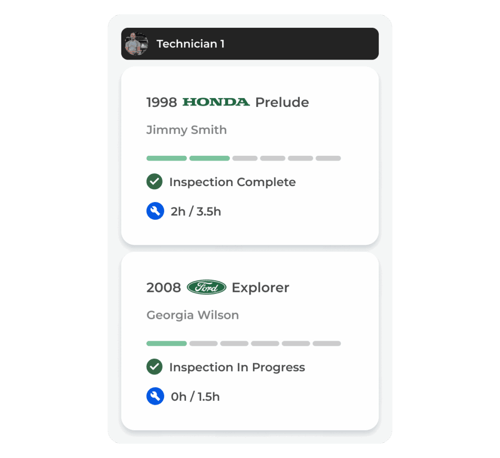
When these systems are in place, advisors can reduce delays and keep work flowing through the shop without unnecessary interruptions.
# **Setting Goals That Actually Drive Performance**
Once you’ve improved visibility and reduced workflow friction, the next step is giving that structure direction. Without clear goals, any shop can fall into inconsistent performance.
Encouraging your team to “pick up the pace” probably won’t lead to meaningful improvement because it doesn’t define what needs to be done in order to achieve that increased pace. Instead, set up clear, measurable goals that all of our technicians and service advisors are aware of. When technicians know exactly what they’re working toward, whether it’s a daily billed hours target, consistent inspection completion, or improved efficiency, they can prioritize differently and manage their time accordingly.
Goals also create alignment across the team. When everyone understands the targets, service advisors, technicians, and managers can work together to support them. For example, if the goal is to reduce downtime between jobs, that becomes a shared priority, not just a technician's responsibility.
# **Productivity Is Built**
If your team isn’t producing as much work as you expect, take a closer look at how the work is getting done. Technician productivity is the result of workflow, communication, and visibility working in harmony.
When you remove the obstacles, performance improves naturally. Productivity becomes predictable and scalable. If you’re ready to stop the leaks and start growing, see how AutoVitals works in a real shop environment by [booking a quick demo](https://www.autovitals.com/schedule-a-demonstration/).
## Read On
### [Key Performance Indicators to Transform Your Shop Operations In Episode 192 of Digital Talk Shop Radio, industry professionals Roy Foster of Roy Foster’s...](https://blog.autovitals.com/key-performance-indicators-to-transform-your-shop-operations)
### [4 Bookkeeping Best Practices for Auto Repair Shops Bookkeeping is a must for all businesses, but auto repair shops are particularly prone to the need...](https://blog.autovitals.com/4-bookkeeping-best-practices-for-auto-repair-shops)
### [7 Website Metrics to Track for Auto Shops As an auto repair shop owner, your website is one of the most powerful tools you have for...](https://blog.autovitals.com/7-website-metrics-for-auto-shops)
### Posts by Topic
- [Digital Shop (47)](https://blog.autovitals.com/tag/digital-shop)
- [auto repair shop (44)](https://blog.autovitals.com/tag/auto-repair-shop)
- [automotive shop management software (31)](https://blog.autovitals.com/tag/automotive-shop-management-software)
- [Auto Shop (29)](https://blog.autovitals.com/tag/auto-shop)
- [Autovitals (29)](https://blog.autovitals.com/tag/autovitals)
- [DVI (29)](https://blog.autovitals.com/tag/dvi)
- [shop management (25)](https://blog.autovitals.com/tag/shop-management)
- [workflow (18)](https://blog.autovitals.com/tag/workflow)
- [Digital Marketing (17)](https://blog.autovitals.com/tag/digital-marketing)
- [BCP (16)](https://blog.autovitals.com/tag/bcp)
- [CRM (15)](https://blog.autovitals.com/tag/crm)
- [auto repair shop marketing (15)](https://blog.autovitals.com/tag/auto-repair-shop-marketing)
- [Staff Buy-In (14)](https://blog.autovitals.com/tag/staff-buy-in)
- [Best Practice (13)](https://blog.autovitals.com/tag/best-practice)
- [aro (13)](https://blog.autovitals.com/tag/aro)
- [Consistency (11)](https://blog.autovitals.com/tag/consistency)
- [Digital Vehicle Inspection (11)](https://blog.autovitals.com/tag/digital-vehicle-inspection)
- [Process Change (11)](https://blog.autovitals.com/tag/process-change)
- [Tech (11)](https://blog.autovitals.com/tag/tech)
- [service advisor (11)](https://blog.autovitals.com/tag/service-advisor)
- [COVID-19 (10)](https://blog.autovitals.com/tag/covid-19)
- [KPIs (10)](https://blog.autovitals.com/tag/kpis)
- [Shop Culture (10)](https://blog.autovitals.com/tag/shop-culture)
- [Websites (10)](https://blog.autovitals.com/tag/websites)
- [AutoVitals News (8)](https://blog.autovitals.com/tag/autovitals-news)
- [Integration (8)](https://blog.autovitals.com/tag/integration)
- [Website (8)](https://blog.autovitals.com/tag/website)
- [automotive shop software (8)](https://blog.autovitals.com/tag/automotive-shop-software)
- [Announcement (7)](https://blog.autovitals.com/tag/announcement)
- [Automotive Technician (7)](https://blog.autovitals.com/tag/automotive-technician)
- [Press Release (7)](https://blog.autovitals.com/tag/press-release)
- [Partners (6)](https://blog.autovitals.com/tag/partners)
- [auto repair marketing company (6)](https://blog.autovitals.com/tag/auto-repair-marketing-company)
- [auto repair shop SEO (6)](https://blog.autovitals.com/tag/auto-repair-shop-seo)
- [New Features (5)](https://blog.autovitals.com/tag/new-features)
- [auto repair services (5)](https://blog.autovitals.com/tag/auto-repair-services)
- [best auto repair software (5)](https://blog.autovitals.com/tag/best-auto-repair-software)
- [Coaching (4)](https://blog.autovitals.com/tag/coaching)
- [Customer Reviews (4)](https://blog.autovitals.com/tag/customer-reviews)
- [Paperless (4)](https://blog.autovitals.com/tag/paperless)
- [Reviews (4)](https://blog.autovitals.com/tag/reviews)
- [auto shop management (4)](https://blog.autovitals.com/tag/auto-shop-management)
- [multishop (4)](https://blog.autovitals.com/tag/multishop)
- [smartflow (4)](https://blog.autovitals.com/tag/smartflow)
- [Automotive Technician Shortage (3)](https://blog.autovitals.com/tag/automotive-technician-shortage)
- [DRIVE Shops (3)](https://blog.autovitals.com/tag/drive-shops)
- [Digital Shop Conference (3)](https://blog.autovitals.com/tag/digital-shop-conference)
- [Industry Events (3)](https://blog.autovitals.com/tag/industry-events)
- [Meineke (3)](https://blog.autovitals.com/tag/meineke)
- [NAPA (3)](https://blog.autovitals.com/tag/napa)
- [Shop-Ware (3)](https://blog.autovitals.com/tag/shop-ware)
- [auto parts inventory (3)](https://blog.autovitals.com/tag/auto-parts-inventory)
- [auto shop efficiency (3)](https://blog.autovitals.com/tag/auto-shop-efficiency)
- [automotive repair invoice app (3)](https://blog.autovitals.com/tag/automotive-repair-invoice-app)
- [creative (3)](https://blog.autovitals.com/tag/creative)
- [drop off (3)](https://blog.autovitals.com/tag/drop-off)
- [training (3)](https://blog.autovitals.com/tag/training)
- [web based auto repair software (3)](https://blog.autovitals.com/tag/web-based-auto-repair-software)
- [Automotive text messaging (2)](https://blog.autovitals.com/tag/automotive-text-messaging)
- [Bookkeeping for auto repair shops (2)](https://blog.autovitals.com/tag/bookkeeping-for-auto-repair-shops)
- [Case Study (2)](https://blog.autovitals.com/tag/case-study)
- [POS (2)](https://blog.autovitals.com/tag/pos)
- [Picture Edits (2)](https://blog.autovitals.com/tag/picture-edits)
- [Protractor (2)](https://blog.autovitals.com/tag/protractor)
- [Recruiting (2)](https://blog.autovitals.com/tag/recruiting)
- [RepairPal (2)](https://blog.autovitals.com/tag/repairpal)
- [TeE-Times (2)](https://blog.autovitals.com/tag/tee-times)
- [The Digital Shop Talk Radio (2)](https://blog.autovitals.com/tag/the-digital-shop-talk-radio)
- [inventory management (2)](https://blog.autovitals.com/tag/inventory-management)
- [loyalty (2)](https://blog.autovitals.com/tag/loyalty)
- [Auto mechanic interview questions (1)](https://blog.autovitals.com/tag/auto-mechanic-interview-questions)
- [BayIQ (1)](https://blog.autovitals.com/tag/bayiq)
- [Building a Bench (1)](https://blog.autovitals.com/tag/building-a-bench)
- [Campaign Manager (1)](https://blog.autovitals.com/tag/campaign-manager)
- [Canned Jobs (1)](https://blog.autovitals.com/tag/canned-jobs)
- [Community (1)](https://blog.autovitals.com/tag/community)
- [GMB (1)](https://blog.autovitals.com/tag/gmb)
- [Guided Inspection (1)](https://blog.autovitals.com/tag/guided-inspection)
- [Hiring (1)](https://blog.autovitals.com/tag/hiring)
- [Interview (1)](https://blog.autovitals.com/tag/interview)
- [MRT (1)](https://blog.autovitals.com/tag/mrt)
- [Motorist Approval (1)](https://blog.autovitals.com/tag/motorist-approval)
- [Q&A (1)](https://blog.autovitals.com/tag/qa)
- [Remote Work (1)](https://blog.autovitals.com/tag/remote-work)
- [Service Writer (1)](https://blog.autovitals.com/tag/service-writer)
- [TVP (1)](https://blog.autovitals.com/tag/tvp)
- [Tekmetric (1)](https://blog.autovitals.com/tag/tekmetric)
- [The Digital Shop Summit (1)](https://blog.autovitals.com/tag/the-digital-shop-summit)
- [Who's in our shop? (1)](https://blog.autovitals.com/tag/whos-in-our-shop)
- [auto parts (1)](https://blog.autovitals.com/tag/auto-parts)
- [auto repair shop financing (1)](https://blog.autovitals.com/tag/auto-repair-shop-financing)
- [best auto repair shop websites (1)](https://blog.autovitals.com/tag/best-auto-repair-shop-websites)
- [estimate (1)](https://blog.autovitals.com/tag/estimate)
- [financing (1)](https://blog.autovitals.com/tag/financing)
- [inflation (1)](https://blog.autovitals.com/tag/inflation)
- [marketing plan (1)](https://blog.autovitals.com/tag/marketing-plan)
- [parts catalog (1)](https://blog.autovitals.com/tag/parts-catalog)
- [pricing (1)](https://blog.autovitals.com/tag/pricing)
- [retention (1)](https://blog.autovitals.com/tag/retention)
- [script (1)](https://blog.autovitals.com/tag/script)
- [social media (1)](https://blog.autovitals.com/tag/social-media)
- [social media marketing (1)](https://blog.autovitals.com/tag/social-media-marketing)
see all
### Subscribe to our blog
[Back To Top](https://blog.autovitals.com/how-to-turn-a-busy-shop-into-a-productive-one#toTop)
[](https://www.autovitals.com/)
**AutoVitals**The automotive industry’s leading provider of integrated solutions for internet marketing, motorist engagement and customer retention.
### Contact Us
**Phone:** (866) 949-2848
**Email:** sales@autovitalsinc.com
**Facebook:** @AutoVitalsUpdate
-
-
-
-
### Solutions
[**DVI.X**Digital Vehicle Inspections](https://www.autovitals.com/dvi-x/) [**SmartFlow.X**Workflow Management](https://www.autovitals.com/smartflow-x/) [**Digital Shop.X** Inspections, Workflow, Website, & CRM](https://www.autovitals.com/digital-shop-x/)
### The Digital Shop®
[Best Practices Library](https://www.autovitals.com/best-practices-2/) [The Digital Shop® Conference 2021](https://www.autovitals.com/conference/) [Digital Shop® Talk Radio](https://help.autovitals.com/podcast/) [Digital Shop® Online Summit](https://www.autovitals.com/onlinesummit/) [Schedule a Demonstration](https://www.autovitals.com/schedule-a-demonstration/)
©2026 AutoVitals, Inc.
- [Home](https://www.autovitals.com/home/)
- [Solutions](https://www.autovitals.com/solutions/)
- [Support](https://www.autovitals.com/contact/)